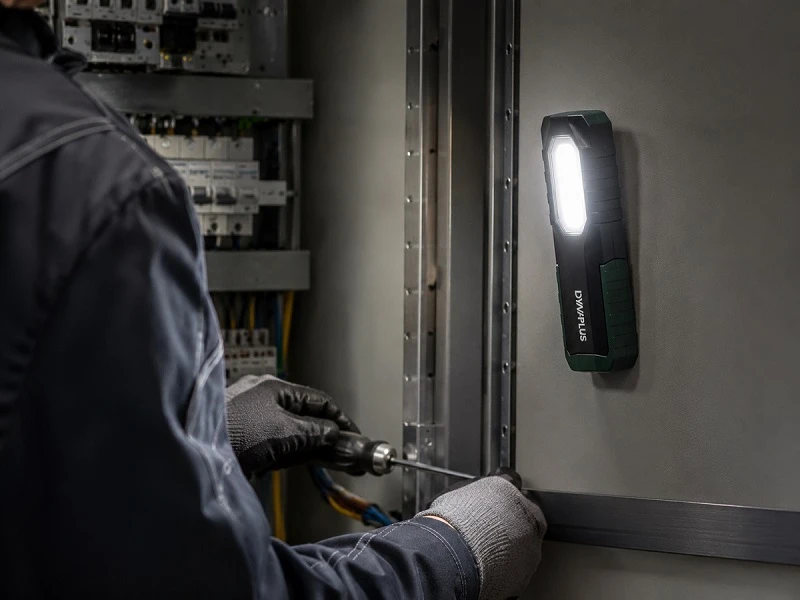
Do Magnetic Work Lights Hold Securely?
Will your consumers report any issues regarding the instability of the magnetic suction work lights? A magnetic work light can appear securely attached to a steel surface and still slide, rotate, or lose its lighting position during actual use.
The reason is simple: magnet strength alone does not determine real-world stability.
A work light may perform well when mounted flat against a clean steel plate but behave differently when installed vertically, overhead, or with the lamp head extended. Product weight, center of gravity, pivot-joint retention, mounting direction, surface condition, and the magnetic base design all affect the final result.
For buyers evaluating a magnetic work light, the key question is therefore not simply: How strong is the magnet?
A more useful question is:
Can the complete product remain securely mounted and keep its intended lighting angle under real conditions of use?
This article explains how magnetic holding performance should be understood and evaluated.
What Makes a Magnetic Work Light Truly Hands-Free?
The main purpose of a magnetic work light is to provide hands-free illumination.
Whether it is attached inside an engine bay, on a steel cabinet, beneath a vehicle hood, or on industrial equipment, reliable performance depends on more than preventing the product from falling.
A stable magnetic work light requires three functions to work together:
Mounting stability - the base should resist detaching, sliding, and unwanted rotation.
Angle retention - the hinge or pivot should hold the selected position.
Beam positioning - the light should remain directed toward the intended work area.
A strong magnet cannot compensate for a loose pivot joint. Likewise, a reliable hinge provides little value if the entire product slides down the mounting surface.
Hands-free performance = secure mounting + stable angle retention + consistent beam positioning
This is also why magnetic performance should be evaluated as part of the complete product design rather than as an isolated magnet specification.
For a broader overview of work-light categories, brightness, and power options, see our Work Light Guide.
Why Can a "Strong" Magnetic Work Light Still Slip or Rotate?
The phrase "strong magnet" does not provide enough technical information on its own.
It does not explain: How the magnetic force was measured / What surface was used / In which direction the force was applied / How heavy the complete product is / Whether the lamp head changes position during use
These factors become particularly important when a product moves from a controlled pull-force test to real working conditions.
Pull Force vs. Real-World Holding Performance
Magnetic pull force is commonly expressed in Newtons (N).
A Newton is a unit of force. In magnetic applications, pull force generally refers to the force required to separate a magnet or magnetic assembly from a ferromagnetic surface under defined test conditions.
For reference: 1 kgf is approximately equal to 9.81 N.
However, a pull-force value should not be confused with magnetic field strength measured in Gauss or Tesla.
More importantly, a high pull-force result does not automatically mean that a work light will remain equally stable in every mounting position. In a typical laboratory pull-force test, the magnet is pulled directly away from a clean and flat steel plate. In real use, the forces may be completely different.
|
Factor |
Pull-Force Test |
Real Vertical or Overhead Use |
|
Force direction |
Direct separation from the surface |
Sliding, rotation, or gravity-related loading |
|
Surface |
Clean, flat, uniform steel |
Painted, oily, curved, thin, or uneven steel |
|
Main measurement |
Maximum separation force |
Combined effect of attraction, friction, weight, and geometry |
|
Best use |
Comparing magnetic assemblies under the same conditions |
Evaluating actual product stability |
A work light can therefore have a high magnetic pull-force value and still slide down a vertical surface. This happens because vertical stability depends not only on magnetic attraction but also on friction between the magnetic base and the mounting surface.
Paint, oil, dust, surface coatings, and product geometry can all change the result. High pull force does not automatically equal high real-world stability.
How Bright Max Evaluates Magnetic Holding Capacity
In our experience developing magnetic work lights, the magnetic force required for a product should not be evaluated only against its own static weight.
Bright Max uses an internal benchmark of approximately four times the product's own weight when evaluating the basic holding capacity of magnetic products. And we will conduct repeated tests in actual usage scenarios.
This provides an additional margin beyond the product's static load under controlled evaluation conditions.
However, this internal benchmark should not be interpreted as a guarantee that the product can safely withstand every possible force or mounting situation.
Actual performance can still change depending on:
- Mounting direction
- Surface material and thickness
- Surface coatings or contamination
- Product angle and center of gravity
- Contact area
- Product movement or vibration
For this reason, we treat magnetic holding force as an important technical indicator, but not the only indicator of whether a magnetic work light will remain stable during use. The complete product must also be evaluated in representative mounting positions.
How Product Weight and Center of Gravity Affect Stability
Product weight is an obvious factor in magnetic stability, but weight distribution can be equally important.
A heavier battery or housing increases the load applied to the magnetic base. However, simply making a work light lighter is not always the best solution, as battery capacity, runtime, durability, and housing strength must also be considered.
The more important question is: Where is the product's center of gravity relative to the magnetic mounting point?
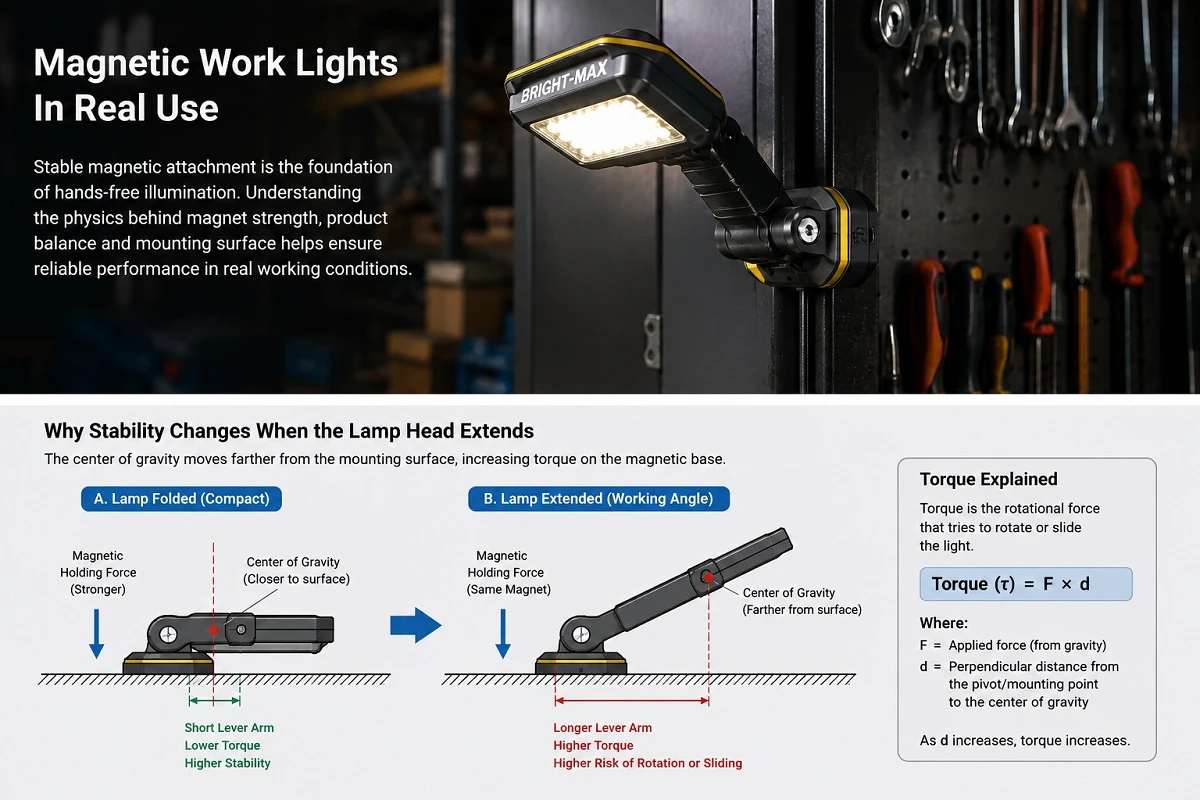
When the lamp head or handle extends away from the mounting surface, the center of gravity moves outward.
This increases the turning effect, or torque, acting on the magnetic base.
In simplified form: Torque = Force × Distance
As the distance between the center of gravity and the mounting point increases, the tendency of the product to rotate also increases. This explains why a magnetic work light may appear stable when folded flat but begin to rotate or slide once the lamp head is extended to illuminate a larger work area. The magnet itself has not necessarily become weaker. The geometry of the complete product has changed.
Surface Material and Condition Also Matter
A magnetic work light requires a suitable ferromagnetic surface. Steel surfaces can provide effective magnetic attachment, but actual performance can still vary significantly.
Important factors include:
- Steel thickness
- Surface flatness
- Curvature
- Paint or powder coating
- Oil, dust, or rust
- Contact area between the magnetic base and the surface
Thin steel may provide lower effective holding performance than the thick, flat steel plate used during a controlled pull-force test. Likewise, a protective rubber pad can improve friction and help protect the mounting surface from scratches, while also creating a small gap between the magnet and the steel. That gap can reduce magnetic attraction.
This means that magnetic base design requires a balance between: Holding force / Friction / Surface protection / Contact distance
The same work light may therefore perform differently on a workshop cabinet, vehicle body, equipment enclosure, or steel shelving.
How Should Magnetic Work Light Stability Be Tested?
No single pull-force number can represent every mounting condition.
Test Vertical Holding
Mount the work light on a vertical steel surface. Test the product with the lamp: Folded/At a mid-angle/At its maximum intended working angle.
Observe whether the product detaches, slides, rotates, or gradually changes position.
The product should not be evaluated only during the first few seconds after mounting.
Test Overhead Holding
For applications such as vehicle hoods, enclosures, or steel shelving, overhead mounting should be evaluated separately. The loading direction is different from vertical mounting, so the result should not simply be assumed from a standard pull-force test.
Test the Maximum Pivot Angle
The magnetic base and pivot joint should be evaluated separately.
A product may have sufficient magnetic holding capacity while the lamp head itself gradually drops because the pivot loses retention. Repeated angle adjustment can also reveal whether the joint becomes loose over time.
How Bright Max Supports Magnetic Work Light Evaluation
In our experience, magnetic pull force alone is rarely enough to predict real-world stability. Product weight, center of gravity, mounting angle, surface condition, and pivot structure can significantly affect the final result.
During product development and sample evaluation, Bright Max can consider factors such as:
Product weight / Magnet configuration / Magnetic holding capacity / Vertical and overhead mounting / Surface conditions / Lamp or handle angle / Application-specific holding requirements
Bright Max operates TA, QA, and QC processes supported by a professional quality team and independent laboratory capabilities, including integrating-sphere measurement, shock and vibration testing, RoHS testing, and other product-specific evaluations.
Where specific mounting requirements are agreed with the customer, relevant evaluation conditions and results can be documented during sample development and approval.
Final Thoughts
A magnetic work light should not be judged by magnet strength alone. Real hands-free performance depends on the relationship between:
magnetic holding force + product weight + center of gravity + mounting direction + surface condition + pivot-joint retention
A high pull-force value measured in Newtons provides useful information about the magnetic assembly, but it cannot independently predict how the complete product will perform on every surface or at every angle.
For buyers, the best approach is to evaluate the complete work light under representative conditions rather than relying only on a specification-sheet claim.
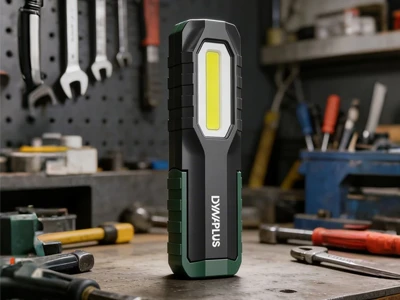
Bright Max's compact magnetic battery work light, for example, combines a 112 g product weight, 350-lumen output, and a 180-degree locking handle. When evaluating this type of design, both the magnetic base and the stability of the product at different handle angles should be considered.
Explore our Magnetic Battery Work Light or contact the Bright Max team to discuss application-specific work-light requirements.
Frequently Asked Questions
1. Does a stronger magnet always mean a more stable work light?
No. Product weight, center of gravity, mounting direction, friction, surface condition, and lamp angle also affect stability.
2. What does magnetic pull force in Newtons mean?
It refers to the force required to separate a magnetic assembly from a ferromagnetic surface under defined test conditions. Higher pull force does not automatically guarantee the same stability in every real-world application.
3. Why does a magnetic work light slip after the lamp head is extended?
Extending the lamp head moves the center of gravity farther from the mounting point and increases torque, making rotation or sliding more likely.
4. Which mounting positions should be tested?
At minimum, vertical mounting, overhead mounting, and the maximum intended lamp-head angle should be evaluated on surfaces relevant to the intended application.
5. What should buyers request before approving a magnetic work light?
Buyers should request product weight, magnet configuration, defined holding-force data, recommended mounting conditions, angle-retention results, and photo or video evidence from relevant tests.